
 Ombra
Position sizing with tick value
Every futures contract has a tick size (the smallest price step) and a tick value (what one tick is worth for one contract). Together they turn price moves into dollars.
ES moves in ticks of 0.25 points, and each tick is worth $12.50, so one point is $50. MES is one tenth of that: $1.25 a tick, $5 a point. NQ is $5 a tick and $20 a point; MNQ is $0.50 a tick and $2 a point.
The sizing sum has three steps. First, decide your dollar risk for the trade. Second, work out the dollar risk of one contract: stop distance in points multiplied by the dollar value of a point. Third, divide the first by the second and round down.
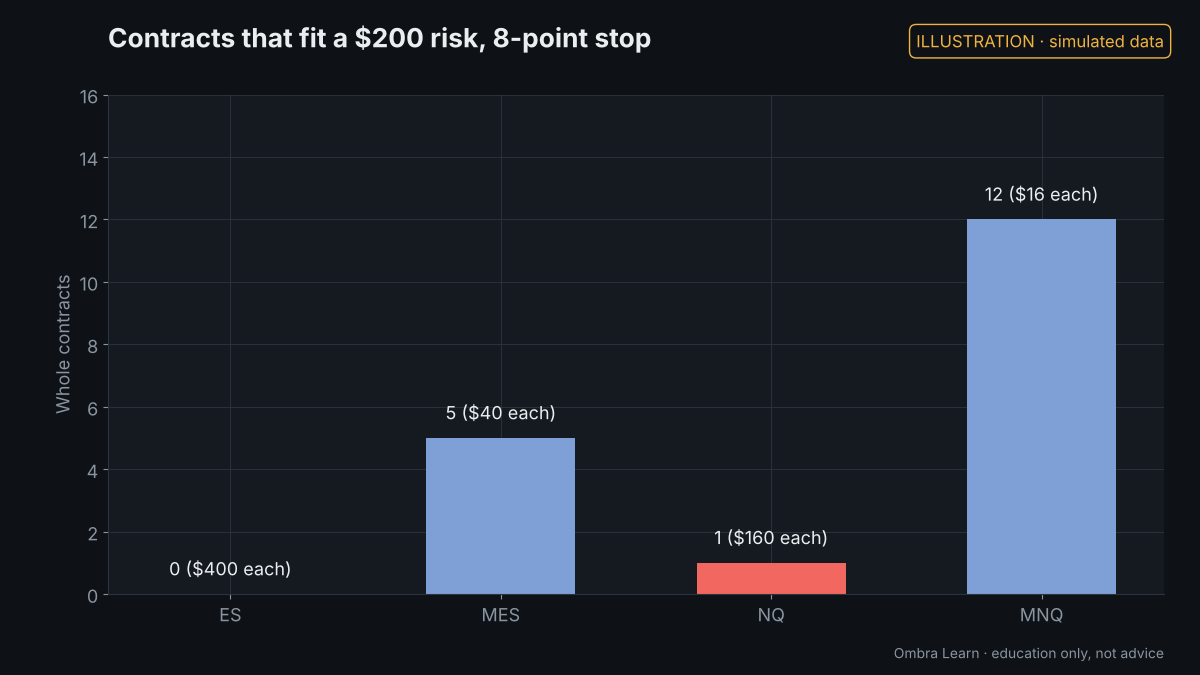
Example: you plan to risk $200 with an 8-point stop. One ES contract risks 8 x $50 = $400, which is more than your budget, so zero ES fit. One MES risks 8 x $5 = $40, so 5 MES fit. One MNQ risks 8 x $2 = $16, so 12 MNQ fit.
Always round down, never up. And remember a stop can fill worse than its price in a fast market, so the real loss can be larger than the sum.
Contract specifications can change, so confirm them on the exchange's own page before you rely on them.
Read: futures contract specs at a glance
Education only. Not advice. Trading futures carries risk of loss; evaluations use simulated accounts.