
 Ombra
Trailing drawdown explained, step by step
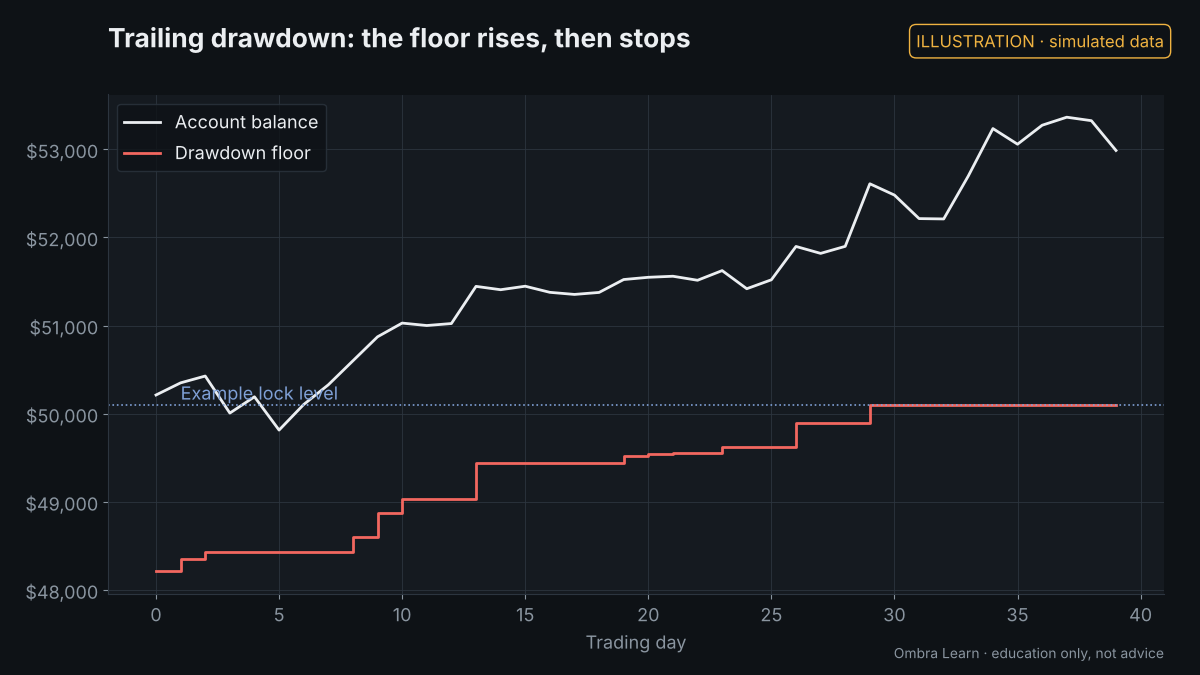
A trailing drawdown is a loss limit that moves. Instead of sitting at a fixed balance, the floor follows your highest balance upwards and never moves back down.
Take a 50K evaluation with a $2,000 trailing drawdown. You start at $50,000, so the floor starts at $48,000. If your balance reaches $51,000, the floor rises to $49,000. If the balance then falls back to $50,200, the floor stays at $49,000. Your room to lose is now $1,200, not $2,000.
This is the part that surprises people: profit you give back still counts against you, because the floor already moved up when you made it.
Many firms stop the floor trailing once it reaches a set level, often around the starting balance. After that it behaves like a fixed limit. The exact level, and whether it applies at all, is different from firm to firm, so check your own rules.
A simple habit helps. At the start of each session, write down two numbers: your current balance and your current floor. The gap between them is the most you can lose today, whatever the day's limit says.
Ombra Watch can alert you as you approach limits you set yourself, so the number is in front of you while you trade. It alerts you; it does not close positions for you.
See how Ombra Watch alerts work
Education only. Not advice. Trading futures carries risk of loss; evaluations use simulated accounts.