
 Ombra
End-of-day vs intraday trailing drawdown
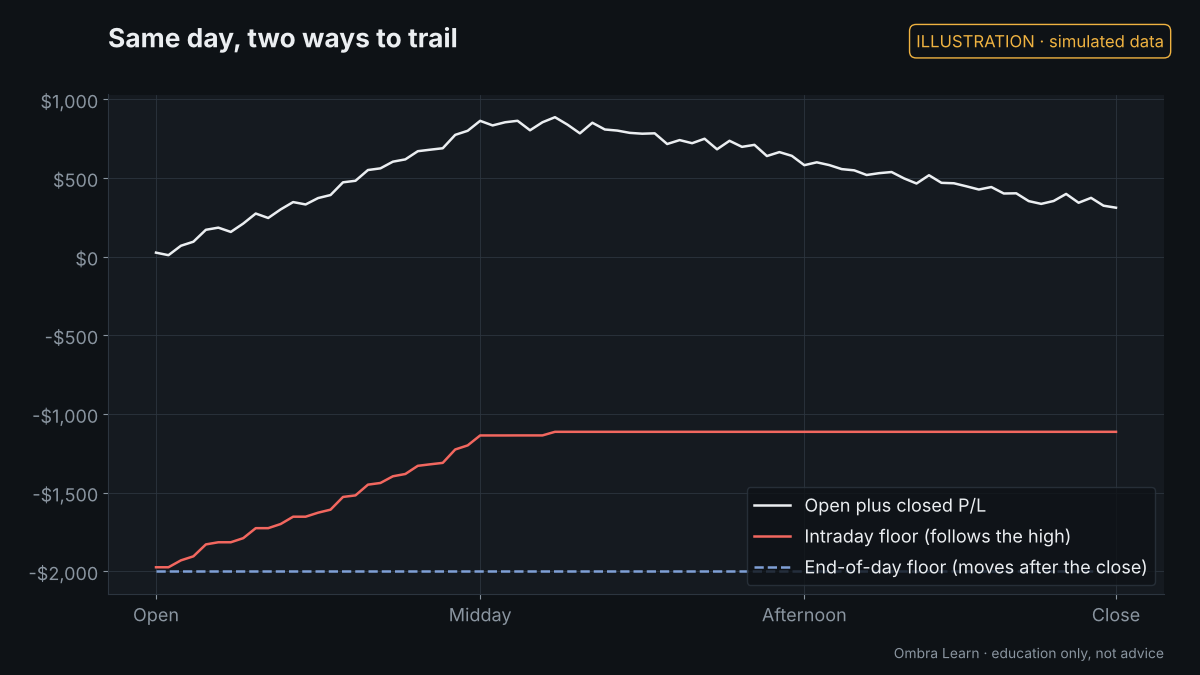
Prop firms describe trailing drawdowns in two main ways: intraday and end of day. The words sound similar, but they measure different things.
An intraday (sometimes called real-time) trailing drawdown follows your highest balance during the session, often including open profit on trades that are still running. If a trade is up $900 at its best and you close it for $300, the floor may already have moved up by $900.
An end-of-day trailing drawdown usually looks only at your balance when the session closes. Moves during the day do not shift the floor; it is recalculated once, after the close. In the same example, the floor would move by the $300 you actually kept.
Intraday is stricter on swings during the day. End of day gives more room during the session, but many firms still enforce a limit in real time against the last end-of-day floor, so you cannot ignore it until the close.
Read the exact wording. Look for whether open profit counts, what time the session ends for the firm, and whether the floor stops trailing at a set level.
Neither type is better for everyone. What matters is that your stop sizes and your plan for giving back open profit match the type you are actually trading under.
Read: trailing drawdown explained
Education only. Not advice. Trading futures carries risk of loss; evaluations use simulated accounts.